Gold price extends the decline, breaks below $4,600
Gold price extended its sell-off during the early NY trading session, hitting a fresh multi-week low of $4,520. The strength of the US dollar and the Federal Reserve’s hawkish stance were the main negative factors pressuring gold prices.
Hawkish Fed and strong dollar drive gold Lower
The strength of the US dollar and the Federal Reserve’s hawkish stance were the main negative factors pressuring gold prices. At its March meeting, the Fed kept rates steady at 3.50%-3.75%, but Chairman Powell indicated that rising oil prices linked to tensions in Iran could elevate inflation in the short term. This is significant because persistent inflation concerns reduce the likelihood of rate cuts, thereby strengthening the dollar.
XAUUSD: short-term technical outlook
Gold prices weakened after breaking below the psychological support level of $5,000 on the daily timeframe, signaling a resumption of the downward trend. The 14-period Relative Strength Index (RSI) moved into the bearish range of 20.00-40.00, indicating established bearish momentum.
Technically, the price fell below $4,600, reaching a low of $4,520 before beginning a modest correction. Key supply and demand levels are highlighted in the accompanying chart.
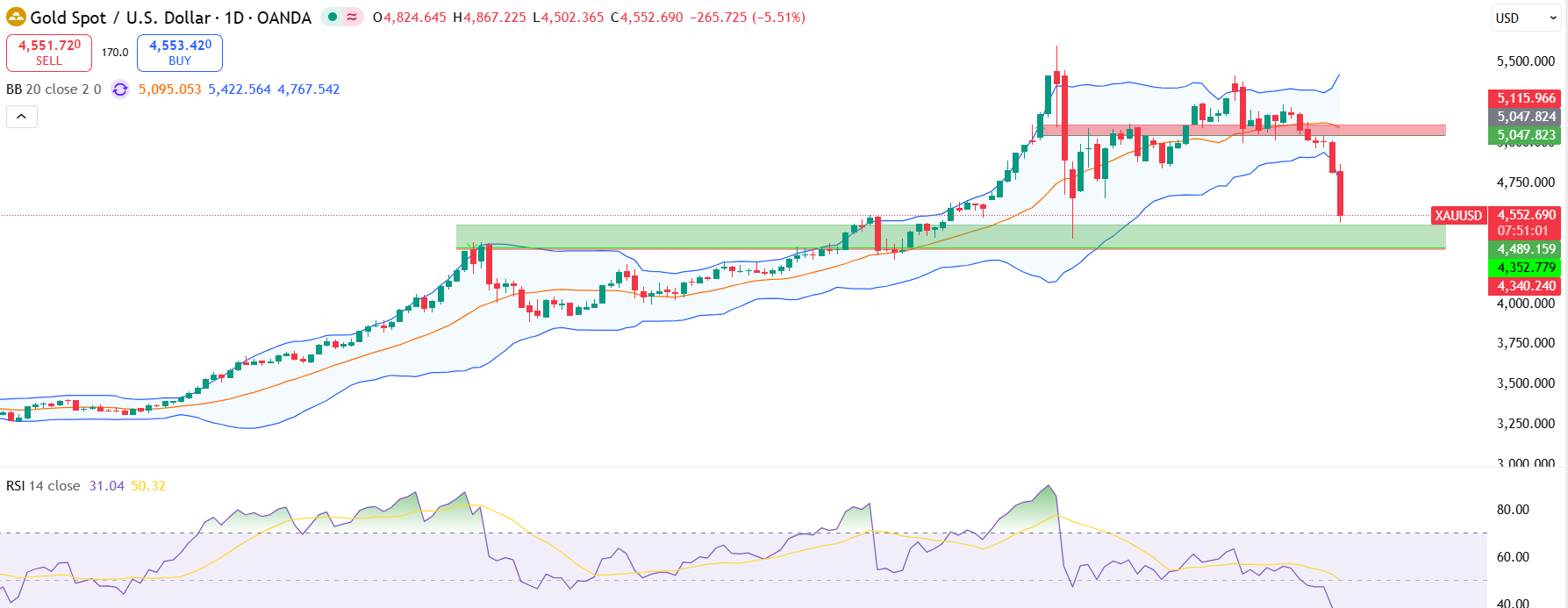
Looking ahead, the next major support zone for bulls is near $4,500/4,480. A relief rebound is expected as long as the price holds above this area, potentially targeting $4,600 and, if momentum strengthens, $4,680. However, a break below $4,500—and especially below $4,480—could trigger an extended sell-off.
In Summary
Gold’s near-term outlook remains sensitive to geopolitical developments and interest rate expectations. The metal is expected to remain volatile in the near term. This volatility presents both challenges and opportunities; if managed wisely, it can become your greatest asset. Investors should closely monitor geopolitical events and Federal Reserve communications to navigate the evolving market conditions effectively.
Disclaimer! This material is not intended as investment advice. Past performance data does not guarantee future profits. Investing in foreign currencies may affect your returns due to their fluctuations. Any securities transaction may result in both profits and losses. The assumptions and expectations set forth in the material are only estimates that may not be accurate and may change according to current economic conditions. These statements do not guarantee future performance.
Relaterte artikler
Dollar catching a relief bid, but conviction remains weak
The US dollar is experiencing a modest recovery on Wednesday morning. However, the current rebound still looks driven more by short covering than by a clearly strong wave of spot buying.
Les mer →USDJPY: Sideways phase before the next move
USD/JPY is trading just below the critical resistance level of 160, a barrier it has tested multiple times without breaking. The currency pair has moved into a sideways consolidation after hitting the critical supply zone.
Les mer →