Gold Tests $4,250 Support After Pullback: Can Buyers Regain Control?
Gold price pulled back to the support zone near $4,250. Investors are watching whether the move toward $4,250 draws buyers or develops into a deeper correction.
Higher Rate Expectations Weigh on Gold
Strong US economic data and expectations that central banks will keep interest rates elevated have added pressure to the metal. Higher rates can make interest-bearing assets more attractive relative to gold, which pays no yield. Rising energy costs have also complicated the outlook by reinforcing inflation concerns and the possibility of tighter monetary policy. Recent reporting has identified those rate and energy pressures as factors weighing on gold.
Geopolitical developments remain another source of uncertainty. Investors are watching the US–Iran conflict for signs of escalation or de-escalation, while the scheduled September 24 meeting between US President Donald Trump and Chinese President Xi Jinping could influence sentiment around trade relations. The market’s response will depend on any concrete outcomes, as well as how they affect the dollar, yields and demand for safe-haven assets.
Technical Outlook: $4,250 Is the First Test
The immediate level to watch is $4,250. If buyers defend that area and the price begins to establish higher short-term lows, gold could stage a rebound toward $4,270 and then $4,300. A brief bounce alone would not establish that the decline has ended: the series of lower highs leaves sellers with the near-term advantage until price recovers more convincingly.
The broader $4,250–$4,220 support zone offers a second test of buying interest. A sustained move back above $4,300 would signal a stronger shift in momentum and weaken the immediate bearish case. A decisive break and hold above that level would put the recent lower-high pattern under greater pressure.
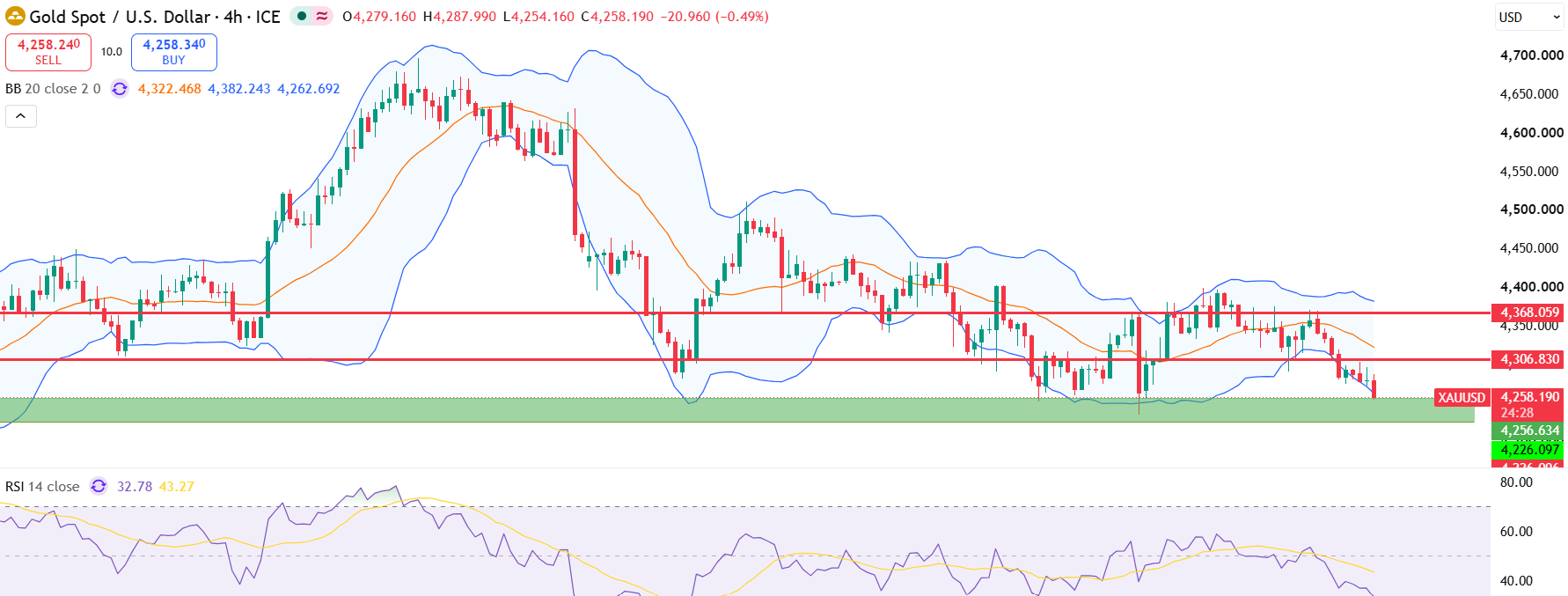
If $4,250 gives way, attention would turn to $4,230–$4,220. A sustained move below that zone would suggest the correction has further to run and call for a reassessment of support at lower levels.
What Could Decide the Next Move?
Gold’s near-term direction may hinge on whether support holds while markets digest changes in US rate expectations and geopolitical news. A rebound from $4,250 would show that buyers remain active, but reclaiming $4,300 is the clearer test of whether they can regain control. Until then, rallies remain vulnerable to selling within the current pattern of lower highs.
Warning! This material is not intended as investment advice. Past performance data does not guarantee future returns. Investing in foreign currencies may affect your returns due to their fluctuations. Any transaction in securities may result in both profits and losses. The assumptions and expectations set forth in this material are only estimates that may not be accurate and may change depending on current economic conditions. These statements do not guarantee future returns.

Meet Syam KP, a financial markets professional with more than fourteen years of experience in forex, CFDs and capital markets. Since 2012, he has worked with several brokerage firms as a trader and market strategist, developing a practical understanding of how markets move. He also holds a qualification from CISI in the United Kingdom.
At FX Junction, Syam turns complex market information into clear and useful insights. His work combines technical and fundamental analysis, portfolio management, risk management and timely commentary on global developments. Whether markets are calm or moving fast, Syam focuses on what matters most: understanding the bigger picture, spotting meaningful opportunities and keeping risk firmly in view.
Relaterte artikler
Gold Rebounds as KOSPI Selloff Triggers Halt
Gold recovers as Asian stocks fall and South Korea’s KOSPI triggers a 20-minute trading halt. The immediate question is whether a softer dollar can sustain the rebound while inflation keeps interest-rate risks in focus.
Les mer →ASML Posts Record Sales and Lifts Its Outlook
ASML reports record sales and a stronger outlook as customers expand their AI investment plans. The immediate question is whether the company can turn rising equipment demand into sustained earnings growth while increasing production capacity.
Les mer →