Bitcoin jumps above $74k, maintaining gains as risk sentiment brightens
Bitcoin (BTCUSD) hit a fresh 4-week high of $74,900 early Tuesday morning before giving up some gains, reflecting improved investor risk appetite.
Bitcoin Reaches a Fresh 4-Week High
Bitcoin (BTCUSD) hit a fresh 4-week high of $74,900 early Tuesday morning before giving up some gains, reflecting improved investor risk appetite. Risk sentiment improved after the US and Iran considered resuming peace talks following a recent breakdown in negotiations. Looking ahead, investors should closely monitor geopolitical developments and US-Iran updates, as any escalation in the Middle East could prompt caution. Additionally, the start of the new quarterly earnings season and Federal Reserve speakers’ comments this week will provide insights into the central bank’s rate cut trajectory.
BTCUSD Technical Outlook
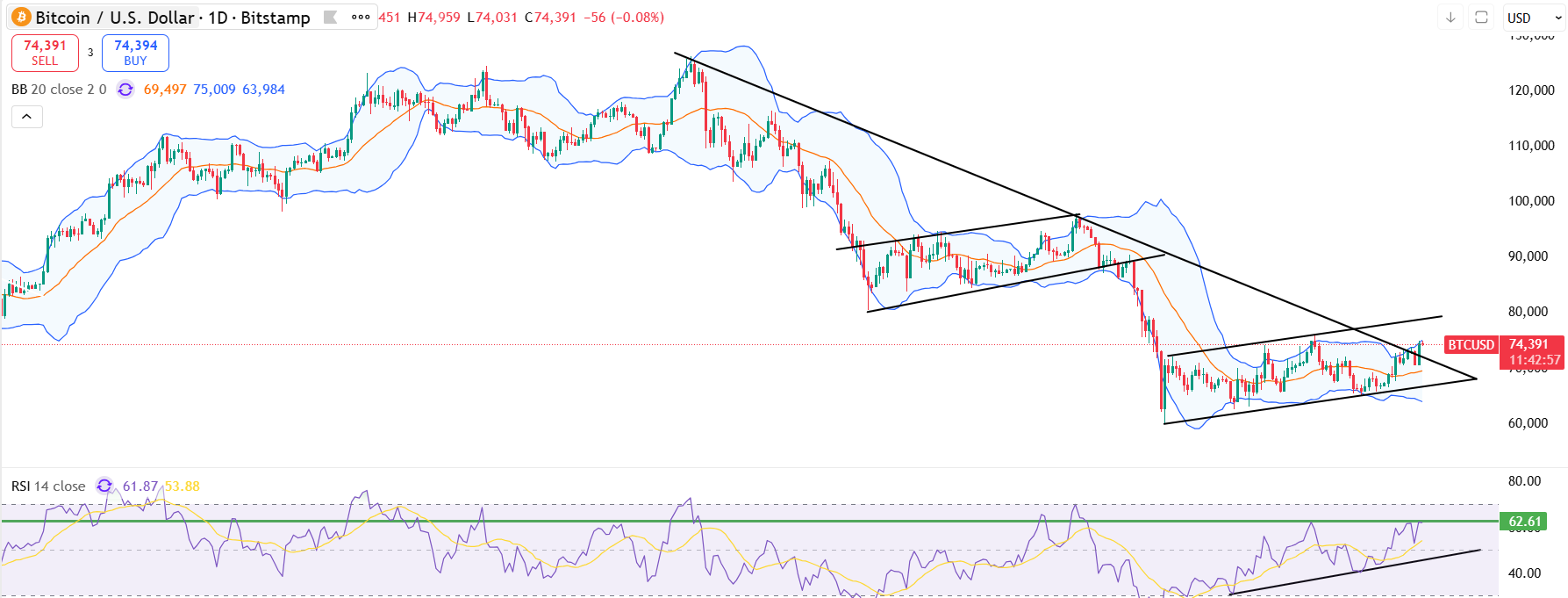
From a technical perspective, Bitcoin is likely to remain strong and stabilize at current levels or move higher. Key resistance lies around $75,800–$76,000, which will be crucial for bulls aiming to reach the next resistance levels at $77,800 and then $79,000. Conversely, a decline toward the $70,000 support level would be important to monitor, as it could signal renewed bearish pressure and challenge the current upward momentum.
Is the Bitcoin Rebound Sustainable?
Since the US-Iran conflict began, cryptocurrencies have emerged as the best-performing risk asset class. BTCUSD is showing early signals of a potential bounce after retesting the $70,000 support zone. The latest fall from $73,600 to $70,000 appears to be a healthy pullback within a broader sideways channel, paving the door for a potential reversal in the coming sessions. However, sharp single-day swings like Monday's bounce necessitate cautious monitoring over the next 2 days. If follow-through buying fails to appear, particularly on higher timeframes, it may signal that the rise was motivated by short-covering or position squaring rather than strong conviction buying.
Warning! This material is not intended as investment advice. Past performance data does not guarantee future returns. Investing in foreign currencies may affect your returns due to their fluctuations. Any transaction in securities may result in both profits and losses. The assumptions and expectations set forth in this material are only estimates that may not be accurate and may change depending on current economic conditions. These statements do not guarantee future returns.

Syam KP
Meet Syam KP, a financial markets professional with more than fourteen years of experience in forex, CFDs and capital markets. Since 2012, he has worked with several brokerage firms as a trader and market strategist, developing a practical understanding of how markets move. He also holds a qualification from CISI in the United Kingdom.
At FX Junction, Syam turns complex market information into clear and useful insights. His work combines technical and fundamental analysis, portfolio management, risk management and timely commentary on global developments. Whether markets are calm or moving fast, Syam focuses on what matters most: understanding the bigger picture, spotting meaningful opportunities and keeping risk firmly in view.
Verwandte Artikel
ASML verzeichnet Rekordumsatz und hebt seine Prognose an
ASML meldet einen Rekordumsatz und einen positiveren Ausblick, da die Kunden ihre Investitionspläne im Bereich KI ausweiten. Die Frage, die sich nun stellt, ist, ob das Unternehmen die steigende Nachfrage nach Anlagen in ein nachhaltiges Gewinnwachstum ummünzen und gleichzeitig seine Produktionskapazitäten ausbauen kann.
Mehr lesen →Ausverkauf von KI-Chips erschüttert das Vertrauen in den Boom
Aktien von KI-Chip-Herstellern brechen ein, da die Konkurrenz aus China und Finanzierungsdruck das Vertrauen in die Branche auf die Probe stellen. Die drängende Frage ist, ob der Ausverkauf eine vorübergehende Neubewertung oder eine dauerhaftere Bedrohung für das Gewinnwachstum widerspiegelt.
Mehr lesen →