Dow Jones Extends Rebound; Focus Shifts to US Consumer Confidence Data
Dow Jones futures extended their gains on Tuesday ahead of the release of a crucial U.S. consumer confidence report. From a technical standpoint, the Dow’s near-term outlook remains neutral to moderately positive following its rebound from last week’s lows.
The Dow began the trading week positively and closed Monday with notable advances. This performance contrasted with declines elsewhere on Wall Street, where the S&P 500 dropped 0.28%, and the technology-heavy Nasdaq Composite fell 0.77%, pressured by semiconductor and artificial intelligence stocks. Dow Jones futures extended gains on Tuesday ahead of the release of a key U.S. consumer confidence report.
Sentiment improved as technology stocks rebounded in premarket trading and investors reduced expectations of a Federal Reserve rate increase in September. Markets nevertheless remained cautious ahead of US consumer confidence data, Nvidia’s quarterly results, key inflation figures and Fed Chair Kevin Warsh’s Jackson Hole speech.
Investors also monitored the possibility of Washington imposing secondary sanctions on countries doing business with Iran. Oil prices declined because these policies lacked swift enforcement and were considered less likely to disrupt global supply compared to the threat of renewed armed conflict.
US consumer confidence in focus
The Conference Board’s August Consumer Confidence Index is scheduled for release at 14:00 GMT. Economists forecast a slight decline to approximately 90.3 from July’s 90.8.
A significantly stronger reading could reinforce confidence in the resilience of U.S. consumer spending but might also raise expectations that interest rates will remain elevated. Conversely, a sharp drop could heighten concerns about economic growth and support the case for the Fed to maintain its current policy stance.
Investors will also be attentive to July new-home sales data and comments from Richmond Federal Reserve President Thomas Barkin.
Dow Jones technical outlook
The Dow’s near-term structure remains neutral to moderately positive following its rebound from last week’s lows.
The 54,000 area represents the first significant resistance zone. A sustained move above it could bring the August record area near 54,700 back into focus. Failure to clear 54,000, however, would leave the index vulnerable to renewed consolidation.
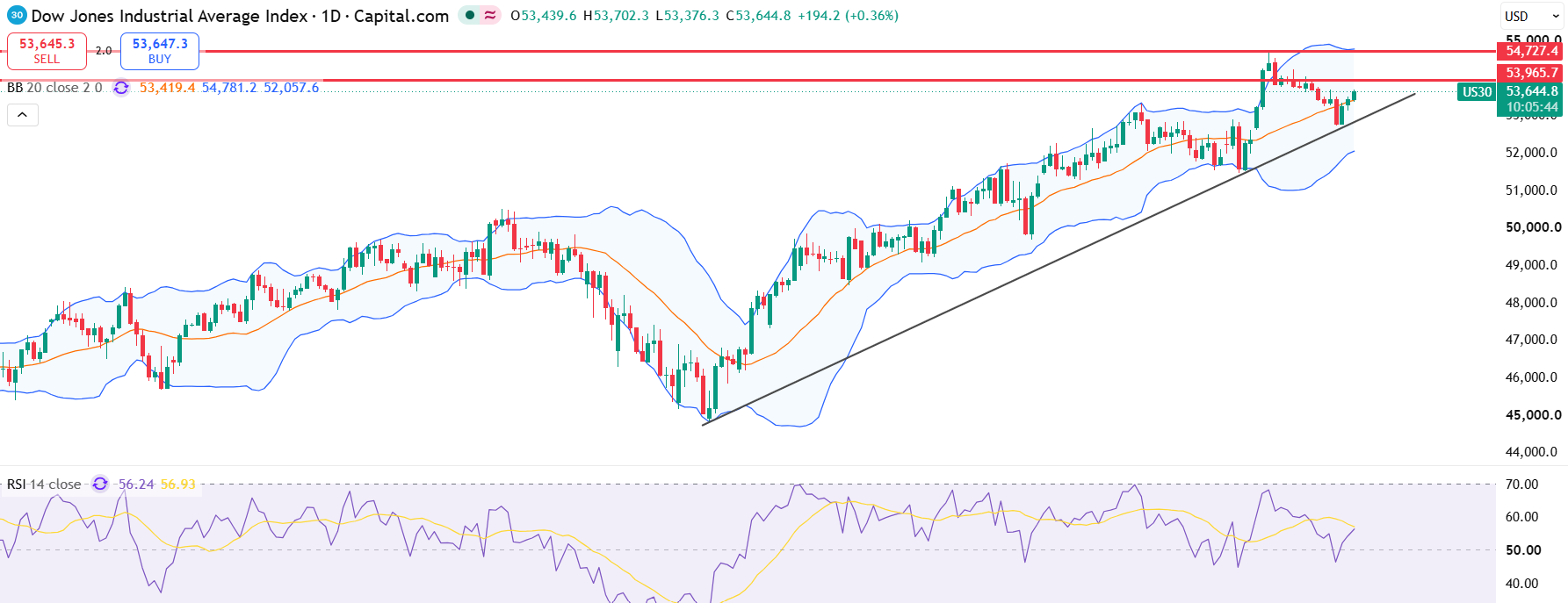
On the downside, the 53,000–52,700 region is the principal near-term support zone. A decisive daily close below that area would weaken the recovery and could expose the index to a deeper pullback. As long as this support holds, buyers retain an opportunity to extend the rebound, although upcoming economic data may determine whether the move develops into a broader advance.
Warning! This material is not intended as investment advice. Past performance data does not guarantee future returns. Investing in foreign currencies may affect your returns due to their fluctuations. Any transaction in securities may result in both profits and losses. The assumptions and expectations set forth in this material are only estimates that may not be accurate and may change depending on current economic conditions. These statements do not guarantee future returns.

Meet Syam KP, a financial markets professional with more than fourteen years of experience in forex, CFDs and capital markets. Since 2012, he has worked with several brokerage firms as a trader and market strategist, developing a practical understanding of how markets move. He also holds a qualification from CISI in the United Kingdom.
At FX Junction, Syam turns complex market information into clear and useful insights. His work combines technical and fundamental analysis, portfolio management, risk management and timely commentary on global developments. Whether markets are calm or moving fast, Syam focuses on what matters most: understanding the bigger picture, spotting meaningful opportunities and keeping risk firmly in view.
Relaterte artikler
Gold Rebounds as KOSPI Selloff Triggers Halt
Gold recovers as Asian stocks fall and South Korea’s KOSPI triggers a 20-minute trading halt. The immediate question is whether a softer dollar can sustain the rebound while inflation keeps interest-rate risks in focus.
Les mer →ASML Posts Record Sales and Lifts Its Outlook
ASML reports record sales and a stronger outlook as customers expand their AI investment plans. The immediate question is whether the company can turn rising equipment demand into sustained earnings growth while increasing production capacity.
Les mer →