HP beats earnings estimates and raises guidance
HP delivered stronger-than-expected third-quarter revenue and earnings while raising its full-year outlook. However, a sharp decline in PC unit shipments, continued pressure on margins, rising memory costs, and the contribution from tariff refunds overshadowed the headline beat, sending shares sharply lower in after-hours trading.
HP Inc. (HPQ) reported fiscal third-quarter results after the market close on Wednesday, August 26, delivering a substantial beat on both revenue and adjusted earnings.
The company also raised its full-year profit and free cash flow outlook, supported by stronger Personal Systems revenue, premium product sales, and continued adoption of AI-enabled PCs. Despite the seemingly strong report, HP shares dropped approximately 9% in extended trading as investors focused on weakening PC shipment volumes and continued pressure on profitability from higher memory and component costs.
The key question for investors is therefore whether HP’s higher prices and growing exposure to AI PCs can offset rising costs and weaker hardware volumes as the company heads into fiscal 2027.
Shares Fall Despite Strong Headline Results
HP shares reacted negatively immediately following the earnings announcement, falling roughly 9% in after-hours trading.
While revenue and earnings exceeded expectations, investors focused on weaker PC shipment volumes and rising component costs, both of which could affect profitability over the coming quarters.
The decline also followed a strong recovery in HP shares from their April lows, potentially encouraging some investors to lock in profits following the earnings release.
HP Easily Beats Wall Street Estimates
HP reported quarterly revenue of $15.7 billion, representing year-over-year growth of 12.5% and comfortably exceeding Wall Street expectations. Adjusted earnings reached $0.83 per share, also above analysts’ estimates. Personal Systems was the main growth driver, with revenue increasing 18% year over year to $11.8 billion.
However, PC unit shipments declined approximately 16%, suggesting that much of the revenue growth was driven by higher pricing and a shift toward more expensive products rather than increasing volumes. This divergence appears to have raised concerns about the underlying strength of PC demand.
Higher Costs Put Margins Under Pressure
Another important issue was profitability within HP’s Personal Systems division.
Operating margin declined to approximately 4.6%, compared with 5.2% in the previous quarter, as higher memory and commodity costs outweighed some of the benefits from price increases. Memory prices have become a growing concern for PC manufacturers as strong demand from AI data centres continues to put pressure on supply.
HP has responded through higher prices, supply-chain adjustments and a greater focus on premium devices. Nevertheless, management expects cost pressures to remain a challenge in the near term.
Higher Guidance Comes With a Caveat
HP raised its full-year adjusted earnings outlook to approximately $3.19 to $3.29 per share, compared with its previous forecast of $2.90 to $3.10. The company also expects fourth-quarter adjusted earnings between $0.69 and $0.79 per share.
However, part of the improvement comes from tariff refunds. HP indicated that approximately $0.11 per share of third-quarter adjusted earnings came from tariff-related benefits, while the full-year outlook includes an estimated $0.19 per-share contribution.
HP Technical Outlook
Technically, HP had entered the earnings release with strong upward momentum after recovering significantly from its April lows near $18. The stock recently moved above the $30 level and approached the upper Bollinger Band around $31.60, while weekly RSI reached approximately 68, indicating strong momentum but also increasingly stretched conditions. The after-hours decline toward approximately $27.90 therefore represents an important technical test.
The $27.50-$28.00 area now stands as the first key support zone. Holding above this level could allow shares to stabilize and eventually retest the $30.50-$31.60 region. A sustained breakout above that area could open the way toward approximately $34.60, which represents the next major resistance level on the weekly chart. Conversely, a decisive break below $27.50 could increase downside pressure, with the moving-average area around $24.90 representing the next important support.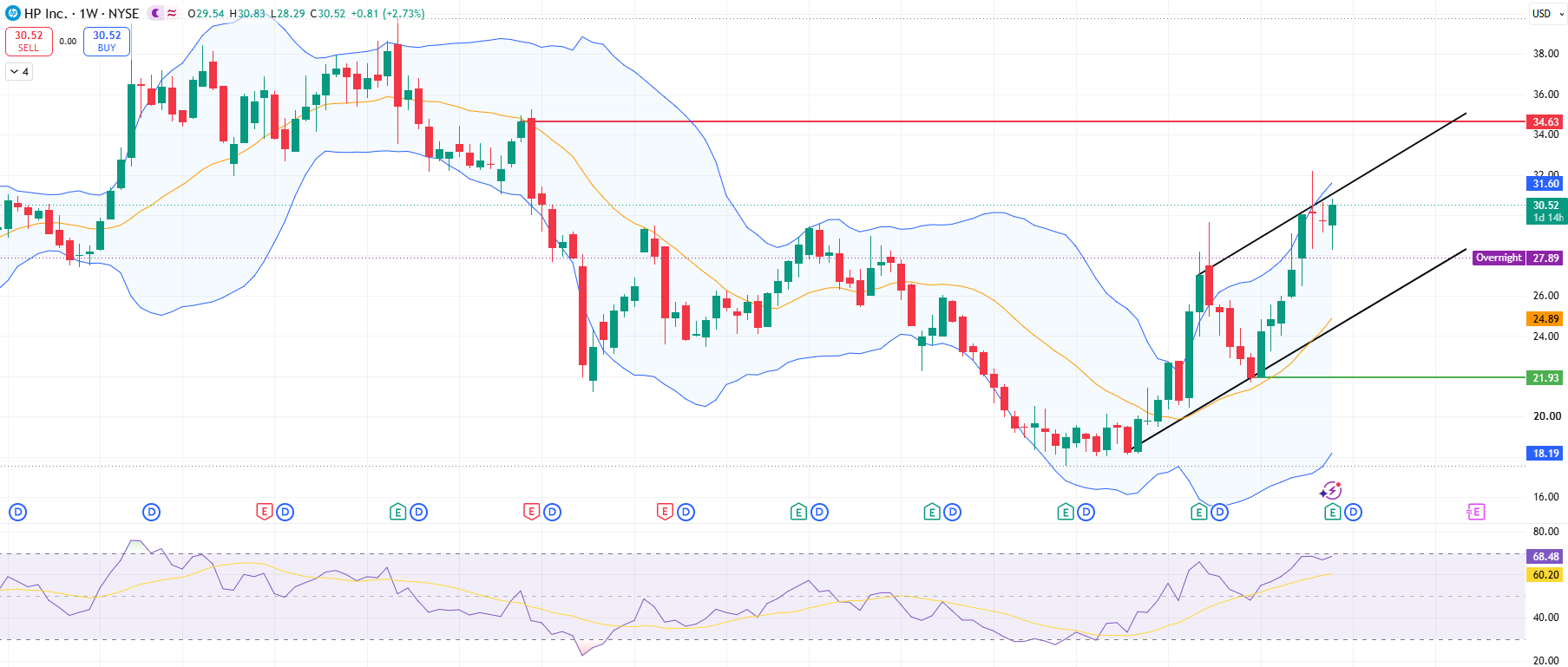
Warning! This material is not intended as investment advice. Past performance data does not guarantee future returns. Investing in foreign currencies may affect your returns due to their fluctuations. Any transaction in securities may result in both profits and losses. The assumptions and expectations set forth in this material are only estimates that may not be accurate and may change depending on current economic conditions. These statements do not guarantee future returns.

Syam KP
Meet Syam KP, a financial markets professional with more than fourteen years of experience in forex, CFDs and capital markets. Since 2012, he has worked with several brokerage firms as a trader and market strategist, developing a practical understanding of how markets move. He also holds a qualification from CISI in the United Kingdom.
At FX Junction, Syam turns complex market information into clear and useful insights. His work combines technical and fundamental analysis, portfolio management, risk management and timely commentary on global developments. Whether markets are calm or moving fast, Syam focuses on what matters most: understanding the bigger picture, spotting meaningful opportunities and keeping risk firmly in view.
Relaterte artikler
ASML Posts Record Sales and Lifts Its Outlook
ASML reports record sales and a stronger outlook as customers expand their AI investment plans. The immediate question is whether the company can turn rising equipment demand into sustained earnings growth while increasing production capacity.
Les mer →AI Chip Selloff Shakes Confidence in the Boom
AI chip stocks tumble as Chinese competition and financing pressures test confidence in the sector. The immediate question is whether the selloff reflects a temporary valuation reset or a more lasting threat to earnings growth.
Les mer →