Gold faces resistance at a crucial level; Focus shifts to U.S. PPI data
Gold retains a bullish medium-term structure, but the speed of its recent advance and its failure to hold near $4,450 leave it vulnerable to further profit-taking.
The precious metal has surged almost 9% this month, buoyed by weaker-than-expected US employment data. Indicators of a softening labor market have dampened expectations of an imminent Federal Reserve rate hike, which has pressured the US dollar and enhanced the attractiveness of non-yielding assets like gold.
Gold Faces Another Inflation Test After CPI
Gold initially extended its advance following the release of the latest US Consumer Price Index data. The momentum subsequently faded, however, as July inflation figures came in broadly in line with market expectations. Renewed tensions between the United States and Iran have added another layer of uncertainty.
Attention now turns to the July Producer Price Index and US Initial Jobless Claims, both of which could generate fresh volatility during the New York session.
The PPI is an important indicator of underlying inflation at the producer level and could influence expectations for Federal Reserve policy. A stronger-than-expected reading would generally be negative for gold, as it could lift interest-rate expectations and US Treasury yields. Conversely, softer producer inflation would likely support the metal by reinforcing the case for a more accommodative policy outlook.
Traders will also monitor remarks from Federal Open Market Committee member Tom Barkin and Cleveland Fed President Beth Hammack for further clues about the direction of monetary policy.
Is a Healthy Correction Developing?
Gold’s rally appears to have paused after the price encountered resistance near the upper boundary of its rising trend. Following the initial pullback, the metal is consolidating around $4,380 as the market absorbs profit-taking and attempts to establish a higher low. Momentum indicators, including the Relative Strength Index, suggest that consolidation could continue while XAU/USD remains below the $4,450 pivot area.
Initial support is located near $4,360. If selling pressure intensifies, the price could move lower toward the $4,340/30 and $4,300 demand zone. This area may attract renewed buying interest if the broader bullish structure remains intact.
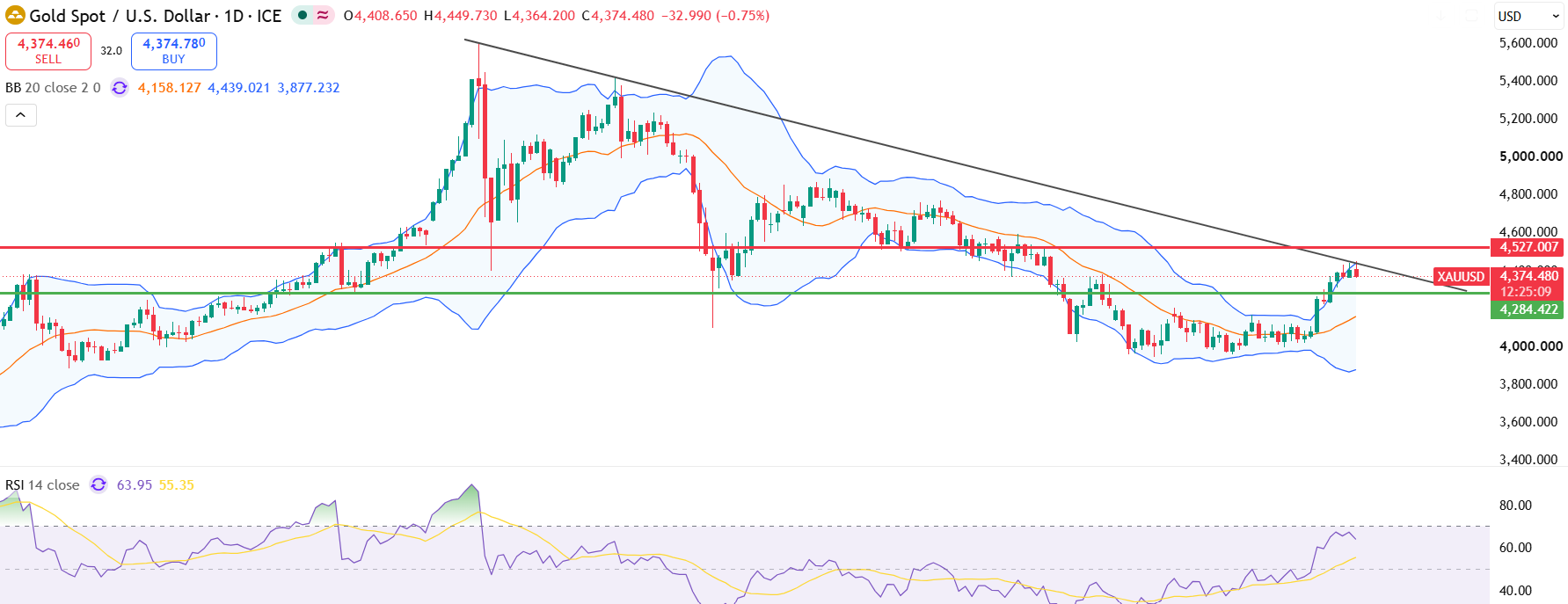
On the upside, a sustained break above $4,450 would return control to buyers and expose the psychological resistance level at $4,500. A decisive move through that barrier would invalidate the near-term correction scenario and strengthen the case for a continuation of the broader advance.
Outlook
Gold retains a bullish medium-term structure, but the speed of its recent advance and its failure to hold near $4,450 leave it vulnerable to further profit-taking. The $4,450–$4,500 region remains a major resistance zone, with the latest test triggering an immediate technical pullback.
Although the broader trend remains constructive, the market appears overstretched following its sharp rebound. Rather than chasing the price at current levels, traders may prefer to wait for a retracement toward the lower demand zone and assess potential buying opportunities from a more favourable entry point.
Warning! This material is not intended as investment advice. Past performance data does not guarantee future returns. Investing in foreign currencies may affect your returns due to their fluctuations. Any transaction in securities may result in both profits and losses. The assumptions and expectations set forth in this material are only estimates that may not be accurate and may change depending on current economic conditions. These statements do not guarantee future returns.

Meet Syam KP, a financial markets professional with more than fourteen years of experience in forex, CFDs and capital markets. Since 2012, he has worked with several brokerage firms as a trader and market strategist, developing a practical understanding of how markets move. He also holds a qualification from CISI in the United Kingdom.
At FX Junction, Syam turns complex market information into clear and useful insights. His work combines technical and fundamental analysis, portfolio management, risk management and timely commentary on global developments. Whether markets are calm or moving fast, Syam focuses on what matters most: understanding the bigger picture, spotting meaningful opportunities and keeping risk firmly in view.
Relaterte artikler
Gold Rebounds as KOSPI Selloff Triggers Halt
Gold recovers as Asian stocks fall and South Korea’s KOSPI triggers a 20-minute trading halt. The immediate question is whether a softer dollar can sustain the rebound while inflation keeps interest-rate risks in focus.
Les mer →ASML Posts Record Sales and Lifts Its Outlook
ASML reports record sales and a stronger outlook as customers expand their AI investment plans. The immediate question is whether the company can turn rising equipment demand into sustained earnings growth while increasing production capacity.
Les mer →