Best Buy beats earnings expectations: The stock falls despite stronger outlook
Best Buy (NYSE: BBY) shares declined despite the company reporting stronger-than-expected second-quarter results and raising its full-year outlook. The electronics retailer exceeded Wall Street expectations for both revenue and earnings, although investors remained cautious following a strong rally in the stock ahead of the report.
Dollar General reported a 3.5% increase in comparable sales during the second quarter and raised its full-year comparable sales growth forecast to between 2.5% and 2.9%. The stronger outlook and continued demand for lower-priced products helped Dollar General shares rise following the announcement.
Ulta Beauty also exceeded Wall Street’s expectations, with quarterly sales reaching approximately $3.04 billion and earnings of $6.55 per share. Meanwhile, Gap raised its full-year profit outlook, although weakness at Old Navy and Athleta continued to offset stronger performance at the company’s namesake Gap brand.
Best Buy beats expectations
Best Buy reported second-quarter adjusted earnings of $1.47 per share on revenue of approximately $9.78 billion, exceeding analysts’ expectations of $1.39 per share and $9.59 billion, respectively. Comparable sales increased 4.1%, while domestic comparable sales advanced 4.5% compared with the previous year.
The company also raised its full-year revenue forecast to between $42.3 billion and $42.8 billion and increased its adjusted earnings guidance to $6.70–$6.90 per share. Nevertheless, Best Buy shares fell approximately 4.4% on Thursday as investors focused on the contribution from a $34 million tariff refund and took profits following the stock’s strong rally earlier this year.
Investors should closely watch several key indicators:
U.S. comparable sales growth
Computing and home theater demand
Online sales and Marketplace performance
Best Buy Ads revenue and profitability
Gross margins and the impact of tariffs
Management’s full-year guidance
Best Buy (BBY) Technical Analysis
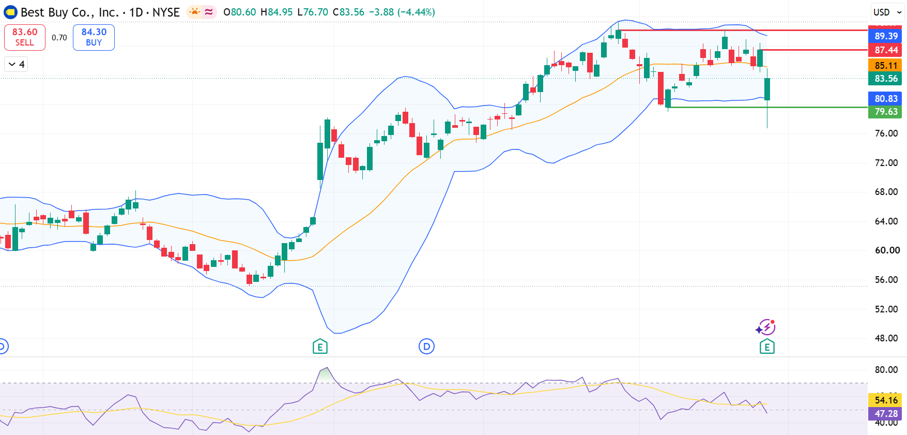
Best Buy (NYSE: BBY) shares came under heavy selling pressure following the company’s quarterly earnings report, falling as much as 12% intraday before recovering to close around $83.56. The stock briefly dropped to $76.70 but rebounded strongly from the lows, suggesting that buyers remain active near the $79–$80 support zone. However, BBY continues to trade below the Bollinger Bands’ middle line near $85.11, while the Relative Strength Index (RSI) has slipped to approximately 47, indicating neutral to slightly bearish momentum. A sustained move above $85.11 could improve the short-term outlook and open the way toward resistance at $87.44 and subsequently $89.39. Conversely, a break below the key support area around $79.63–$80.83 would weaken the technical structure and could expose the stock to another test of the recent low near $76.70.
Warning! This material is not intended as investment advice. Past performance data does not guarantee future returns. Investing in foreign currencies may affect your returns due to their fluctuations. Any transaction in securities may result in both profits and losses. The assumptions and expectations set forth in this material are only estimates that may not be accurate and may change depending on current economic conditions. These statements do not guarantee future returns.

Meet Syam KP, a financial markets professional with more than fourteen years of experience in forex, CFDs and capital markets. Since 2012, he has worked with several brokerage firms as a trader and market strategist, developing a practical understanding of how markets move. He also holds a qualification from CISI in the United Kingdom.
At FX Junction, Syam turns complex market information into clear and useful insights. His work combines technical and fundamental analysis, portfolio management, risk management and timely commentary on global developments. Whether markets are calm or moving fast, Syam focuses on what matters most: understanding the bigger picture, spotting meaningful opportunities and keeping risk firmly in view.
Related Articles
Gold Rebounds as KOSPI Selloff Triggers Halt
Gold recovers as Asian stocks fall and South Korea’s KOSPI triggers a 20-minute trading halt. The immediate question is whether a softer dollar can sustain the rebound while inflation keeps interest-rate risks in focus.
Read More →ASML Posts Record Sales and Lifts Its Outlook
ASML reports record sales and a stronger outlook as customers expand their AI investment plans. The immediate question is whether the company can turn rising equipment demand into sustained earnings growth while increasing production capacity.
Read More →