Bitcoin continues to respect the trendline support
Bitcoin surged past $71,500 on Monday following President Donald Trump’s announcement of a five-day pause on strikes against the Iranian energy sites. However, despite this sharp rebound, Bitcoin is having difficulty maintaining upward momentum, suggesting that sellers are still active.
Momentum lifted after Trump paused Iran strikes
Bitcoin surged past $71,500 on Monday following President Donald Trump’s announcement of a five-day pause on strikes against Iranian energy sites, citing "productive talks" toward resolving hostilities. However, market sentiment turned cautious after Iran denied engaging in talks with the US.
For the rest of the week, Bitcoin’s main drivers will be geopolitical tensions, comments from Federal Reserve policymakers, and movements in the US dollar. Volatility is expected to remain elevated as geopolitical developments unfold, with markets assessing potential impacts on global trade and inflation.
Bitcoin Technical Forecast: Can the bulls sustain recovery?
Bitcoin (BTCUSD) price continues with intraday gains but seems limited in its attempts to move further higher. At the time of writing, Bitcoin trades above $71,000. Therefore, considering the strong upside rebound, there is a danger that if the $BTC fails to settle above $71,500/72,000, it should be used to book profit on long positions again. On the downside, the $70,000 area now seems to protect the immediate downside ahead of $69,000/68,800. Some follow-through selling might expose the $67,600/500 crucial trendline support. Failure to hold above this support and a break below liquidity lows will invalidate the bullish rebound and resume the downtrend.
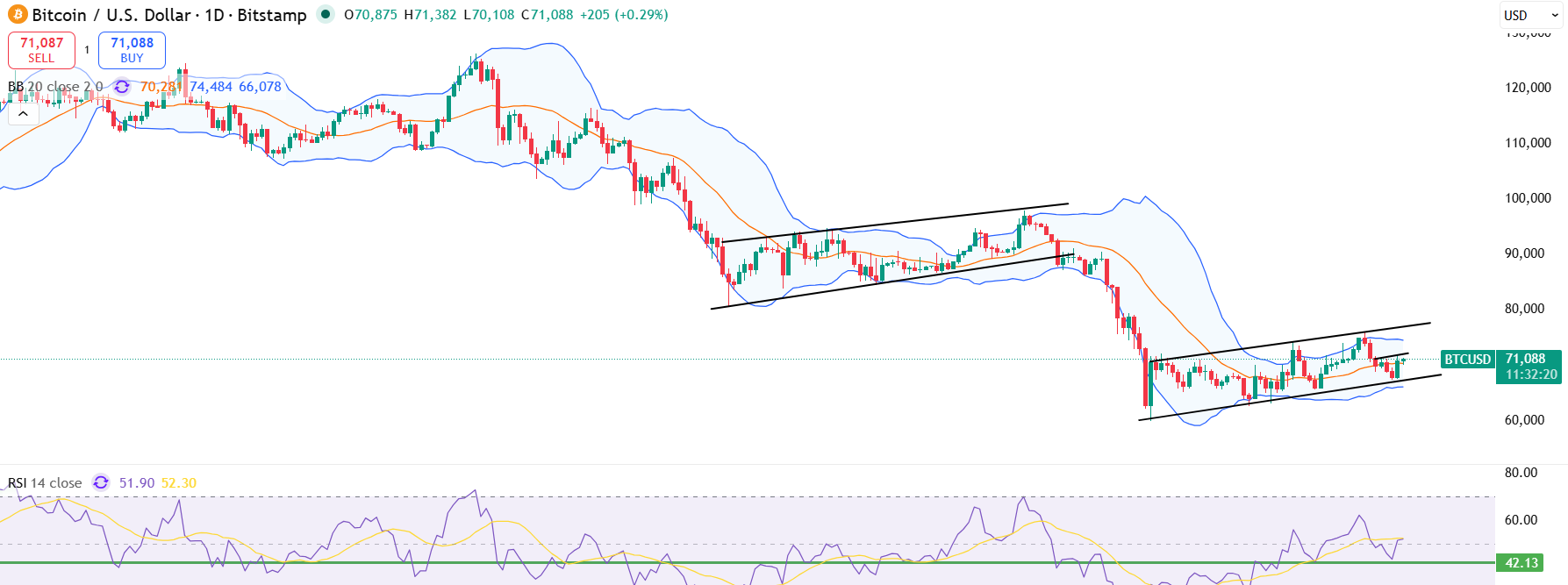
Conversely, if Bitcoin’s recovery gains further momentum, the first resistance to watch is at $72,000, followed by $74,000–74,800. However, the cryptocurrency needs to break and settle above the $75,800/76,000 barrier for a strong upside move.
Disclaimer! This material is not intended as investment advice. Past performance data does not guarantee future profits. Investing in foreign currencies may affect your returns due to their fluctuations. Any securities transaction may result in both profits and losses. The assumptions and expectations set forth in the material are only estimates that may not be accurate and may change according to current economic conditions. These statements do not guarantee future performance.

Syam KP
Meet Syam KP, a financial markets professional with more than fourteen years of experience in forex, CFDs and capital markets. Since 2012, he has worked with several brokerage firms as a trader and market strategist, developing a practical understanding of how markets move. He also holds a qualification from CISI in the United Kingdom.
At FX Junction, Syam turns complex market information into clear and useful insights. His work combines technical and fundamental analysis, portfolio management, risk management and timely commentary on global developments. Whether markets are calm or moving fast, Syam focuses on what matters most: understanding the bigger picture, spotting meaningful opportunities and keeping risk firmly in view.
Related Articles
ASML Posts Record Sales and Lifts Its Outlook
ASML reports record sales and a stronger outlook as customers expand their AI investment plans. The immediate question is whether the company can turn rising equipment demand into sustained earnings growth while increasing production capacity.
Read More →AI Chip Selloff Shakes Confidence in the Boom
AI chip stocks tumble as Chinese competition and financing pressures test confidence in the sector. The immediate question is whether the selloff reflects a temporary valuation reset or a more lasting threat to earnings growth.
Read More →