Dollar Extends Rally on Hawkish Fed Signals
The US Dollar Index, which measures the greenback against a weighted basket of major currencies, retained much of the previous week’s advance. Demand for the dollar was supported by renewed expectations that the Fed may need to tighten monetary policy further—or, at a minimum, postpone any move toward lower interest rates—to return inflation sustainably to its target.
The dollar’s strength also reflects its relative yield advantage. Expectations of higher US interest rates tend to support Treasury yields and make dollar-denominated assets more attractive to international investors.
Fed Officials Maintain a Cautious, Hawkish Tone
Chicago Fed President Austan Goolsbee said on Monday that policymakers must account for persistent supply-side shocks when setting monetary policy. His remarks highlighted the continuing challenge of distinguishing temporary price pressures from inflationary forces that could become more deeply embedded in the economy.
St. Louis Fed President Alberto Musalem delivered a similarly cautious message, indicating that additional interest rate increases could be required if inflation does not continue moving convincingly toward the central bank’s 2% target.
Together, the remarks reinforced the view that Fed officials remain reluctant to declare victory over inflation prematurely. Although policymakers will continue to assess incoming data, the latest commentary suggests that the threshold for easing monetary policy remains high.
Markets Turn Their Attention to US Economic Data
The week begins with a relatively light US macroeconomic calendar, leaving interest-rate expectations, Treasury yields and further comments from Fed officials as the main near-term drivers of the dollar.
Attention will turn to Wednesday’s preliminary US purchasing managers’ indexes. The figures will provide an early indication of economic momentum across the manufacturing and services sectors.
Friday’s durable-goods orders report will provide another important test of economic activity. An upside surprise could strengthen the case for keeping interest rates higher for longer, while disappointing figures may encourage traders to reduce bullish dollar positions.
Technical Outlook: Uptrend Remains Intact Above Key 100 Zone
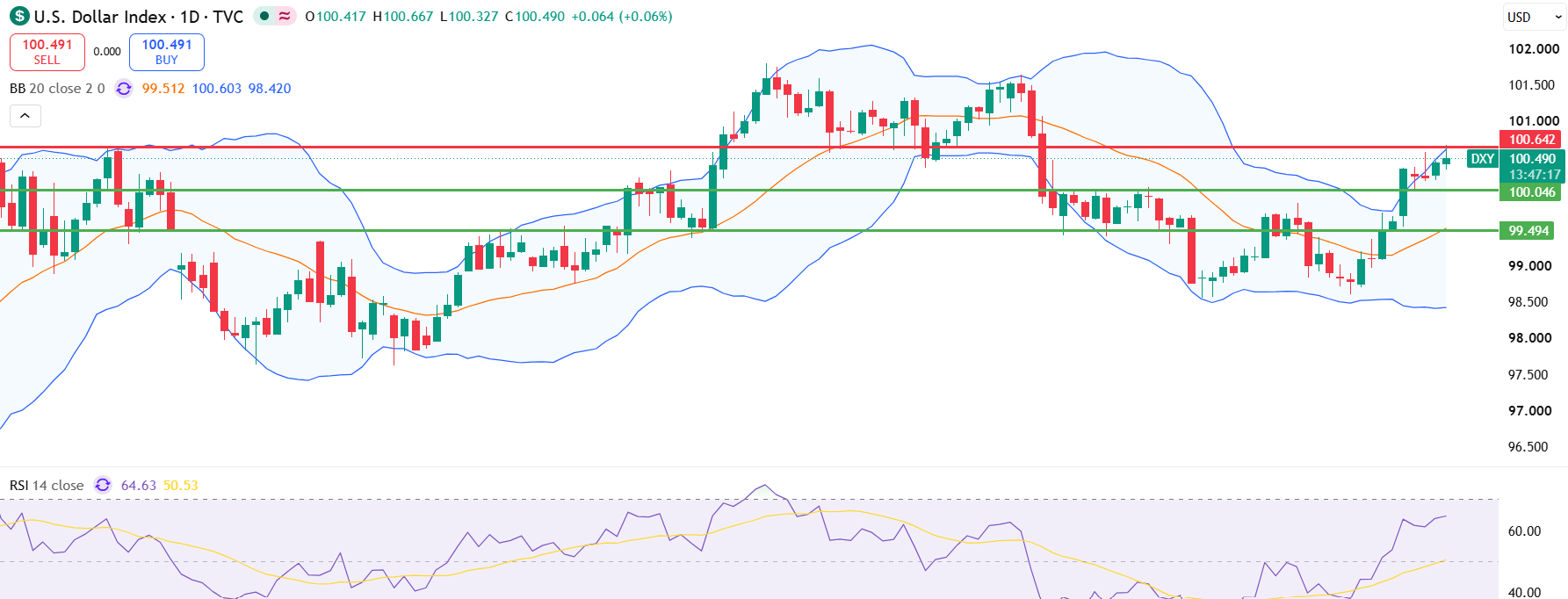
From a technical perspective, the outlook for the US Dollar Index remains constructive. Friday’s correction allowed the index to retreat from short-term overbought territory without materially damaging the broader upward trend.
On the upside, a move above the latest swing high of 100.50 would confirm renewed bullish momentum and potentially open the way toward the next resistance area at 100.80. On the downside, a decisive break below the psychological 100 level would weaken the bullish structure and increase the risk of a correction.
Conclusion: Dollar Outlook Remains Constructive but Data-Dependent
The US dollar remains supported by hawkish Fed rhetoric, elevated interest-rate expectations and a broadly positive technical structure.
However, the sustainability of the rally will depend on whether incoming economic data validate the market’s expectations for a prolonged period of restrictive monetary policy. Strong business-activity and durable-goods figures could provide the catalyst for further gains, while softer releases may trigger renewed profit-taking.
Warning! This material is not intended as investment advice. Past performance data does not guarantee future returns. Investing in foreign currencies may affect your returns due to their fluctuations. Any transaction in securities may result in both profits and losses. The assumptions and expectations set forth in this material are only estimates that may not be accurate and may change depending on current economic conditions. These statements do not guarantee future returns.

Meet Syam KP, a financial markets professional with more than fourteen years of experience in forex, CFDs and capital markets. Since 2012, he has worked with several brokerage firms as a trader and market strategist, developing a practical understanding of how markets move. He also holds a qualification from CISI in the United Kingdom.
At FX Junction, Syam turns complex market information into clear and useful insights. His work combines technical and fundamental analysis, portfolio management, risk management and timely commentary on global developments. Whether markets are calm or moving fast, Syam focuses on what matters most: understanding the bigger picture, spotting meaningful opportunities and keeping risk firmly in view.
Related Articles
China's Factory Inflation Hits Four-Year High as Consumer Demand Weakens
Chinese producer prices rise at their fastest pace in more than four years, driven by higher energy and raw material costs. Yet consumer inflation continues to slow, raising concerns that manufacturers may struggle to protect profit margins as domestic demand remains subdued.
Read More →Nasdaq Plunges 5.5% as AI Investment Concerns Trigger Tech Selloff
The Nasdaq suffers its steepest daily decline in 19 months as investors reassess the outlook for artificial intelligence infrastructure. Growing political opposition to data centers and concerns over financing costs raise questions about whether the sector can sustain its rapid expansion.
Read More →