Euro picked up momentum on the final day of the quarter: What's next?
The rebound in EURUSD has extended further. What does the euro price forecast suggest as we enter the first month of the second quarter?
The euro demonstrated notable strength against the US dollar (USD) on the final day of March, rising over 100 pips to reach a fresh weekly high of 1.1610 early Wednesday. This movement occurred amid a broad USD retreat and month-end balancing. Looking ahead, what does the EUR/USD price forecast suggest as we enter the first month of the second quarter?
EURUSD outlook
The key economic driver for the euro this week will be the manufacturing PMI releases from Germany and the broader Eurozone. These figures are highly anticipated, as they could influence the European Central Bank’s (ECB) interest rate decisions and overall market sentiment.
Meanwhile, the sustainability of recent EUR/USD gains will hinge on the performance of the US dollar and ongoing geopolitical developments. Furthermore, uncertainty surrounding the ECB's rate policy is likely to add to near-term volatility, especially after recent economic data revealed that Eurozone inflation has surged past the European Central Bank's 2% target.
EURUSD technical forecast: Bullish or bearish?
Technically, the EUR/USD currency pair has found support above the 1.1400 level. However, it continues to exhibit mixed signals on the daily chart, as it remains capped below both the 100-day and 200-day simple moving averages (SMA). Currently, a retracement rally is underway, which may attract short sellers looking to enter new positions. Key resistance levels to watch are the 1.1700–1.1730 zone. A decisive break and hold above these levels would be needed to confirm a reversal of the prevailing downtrend and support further upside momentum.
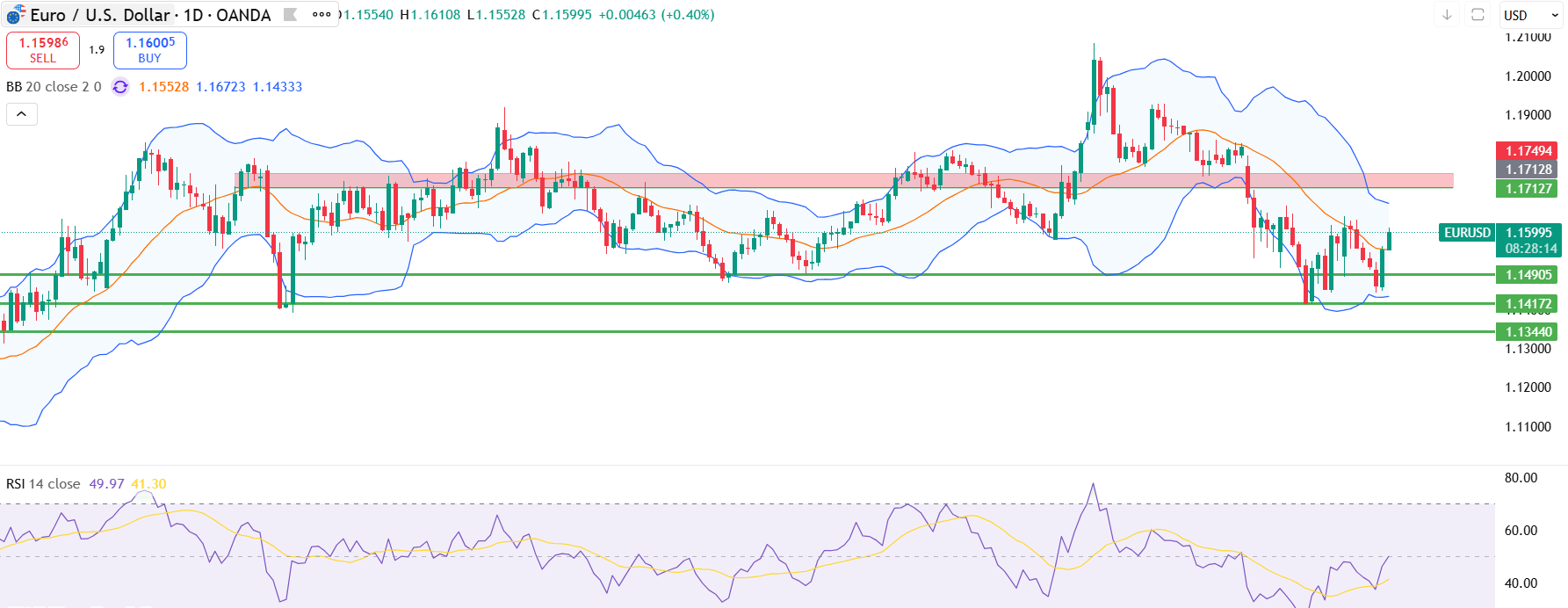
Conversely, failure to surpass the 1.1700–1.1730 resistance zone could lead to renewed bearish pressure. In this scenario, EUR/USD may retest support levels around 1.1410–1.1400, followed by 1.1350 if the downtrend persists.
Summary
For EUR/USD to gain sustained bullish momentum, it must break and maintain above the 1.1700–1.1730 resistance area. Otherwise, the pair remains vulnerable to further losses, with key support levels at 1.1410 and 1.1350 likely to be tested in the near term.
Warning! This material is not intended as investment advice. Past performance data does not guarantee future returns. Investing in foreign currencies may affect your returns due to their fluctuations. Any transaction with securities may result in both profits and losses. The assumptions and expectations set forth in this material are only estimates that may not be accurate and may change depending on current economic conditions. These statements do not guarantee future returns.

Meet Syam KP, a financial markets professional with more than fourteen years of experience in forex, CFDs and capital markets. Since 2012, he has worked with several brokerage firms as a trader and market strategist, developing a practical understanding of how markets move. He also holds a qualification from CISI in the United Kingdom.
At FX Junction, Syam turns complex market information into clear and useful insights. His work combines technical and fundamental analysis, portfolio management, risk management and timely commentary on global developments. Whether markets are calm or moving fast, Syam focuses on what matters most: understanding the bigger picture, spotting meaningful opportunities and keeping risk firmly in view.
Related Articles
Gold Rebounds as KOSPI Selloff Triggers Halt
Gold recovers as Asian stocks fall and South Korea’s KOSPI triggers a 20-minute trading halt. The immediate question is whether a softer dollar can sustain the rebound while inflation keeps interest-rate risks in focus.
Read More →ASML Posts Record Sales and Lifts Its Outlook
ASML reports record sales and a stronger outlook as customers expand their AI investment plans. The immediate question is whether the company can turn rising equipment demand into sustained earnings growth while increasing production capacity.
Read More →