Will Docusign’s Q2 Earnings Give the Stock Fresh Momentum?
DocuSign’s second-quarter results could give the stock fresh momentum, but the bar is higher than simply exceeding consensus estimates by a small margin. The company is scheduled to report its Q2 results after the U.S. market closes on Thursday, September 3.
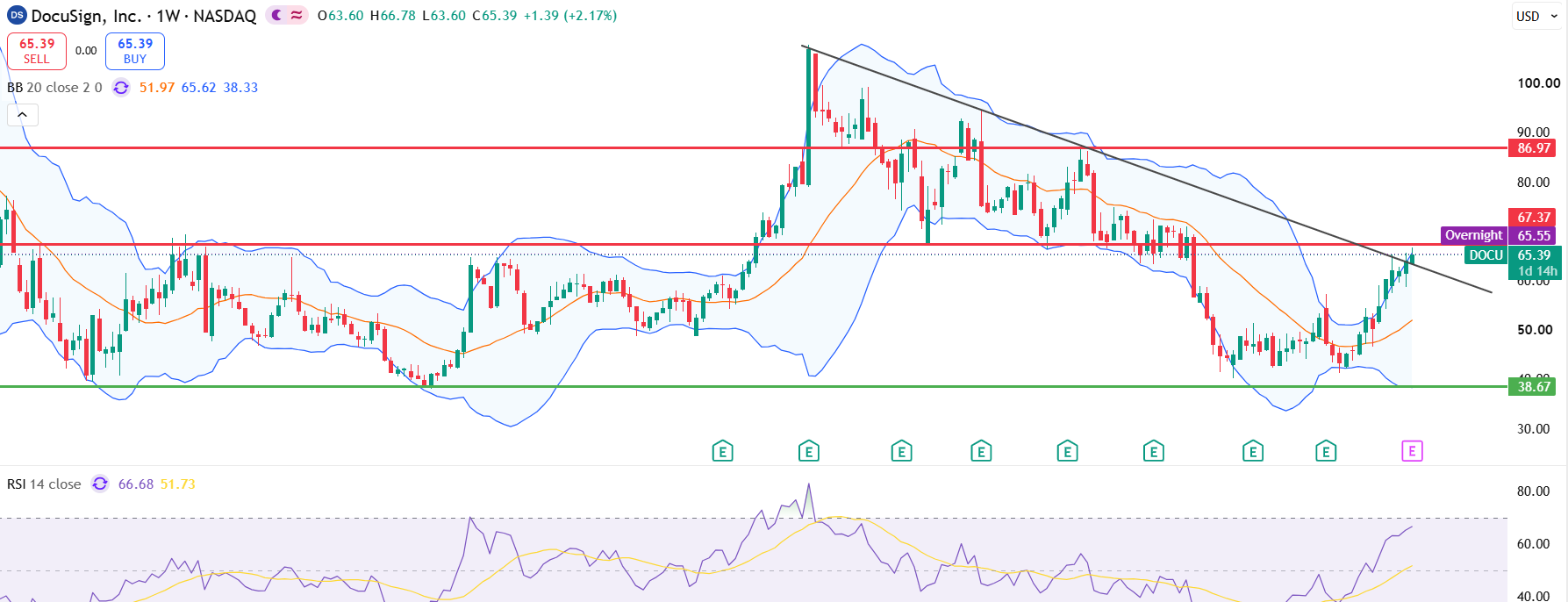
Ahead of the company’s fiscal second-quarter 2027 results, the stock is testing significant resistance between $66.50 and $67. The earnings report could determine whether the recovery develops into a more durable uptrend or stalls near this technical ceiling. A convincing breakout, however, will probably require more than another modest earnings beat.
What Wall Street expects
DocuSign provides electronic-signature solutions and intelligent agreement management software. The company is scheduled to report its fiscal second-quarter 2027 results after the U.S. market closes on Thursday, September 3.
Analysts expect revenue of approximately $867 million, representing growth of slightly more than 8% from the same period a year earlier. That estimate is close to the midpoint of DocuSign’s guidance range of $865 million to $869 million.
Consensus estimates for adjusted earnings vary among data providers but generally fall between $1.00 and $1.09 per diluted share.
A Routine Earnings Beat May Not Be Enough
For investors, the quality of the results and management’s outlook may matter more than a narrow beat of headline estimates.
A bullish report would likely include:
Revenue above the upper end of the company’s $865 million–$869 million guidance range
Continued expansion of the Intelligent Agreement Management platform
Resilient profit margins
An improved full-year outlook
Strong cash flow and further reductions in the number of shares outstanding
Together, these developments could reassure investors that DocuSign’s improving performance is not driven solely by cost discipline and that more durable revenue growth is beginning to emerge.
By contrast, a modest earnings beat achieved mainly through cost reductions or share repurchases may not be enough to push the stock decisively above $67. Cautious management commentary about organic growth, contract renewals, or the pace of IAM adoption could weaken the recent rally.
$DOCU Technical Outlook
The rebound from the $40 area resembles a double-bottom formation, which could support further gains. However, the stock faces immediate resistance between $66.50 and $67.
A decisive close above this zone, accompanied by higher-than-average trading volume, could indicate that buyers have absorbed the available supply and strengthen the case for an extended recovery. Failure to break through—particularly following an average earnings report or a weaker outlook—would increase the risk of fading momentum and a pullback.
The bottom line
DocuSign’s second-quarter results could give the stock fresh momentum, but the bar is higher than simply exceeding consensus estimates by a small margin. The company enters earnings with improving profitability, strong cash flow, and a promising IAM platform strategy. It must still demonstrate that this strategy can generate durable revenue growth.
The setup is therefore balanced. Strong results combined with an improved outlook could help the stock break decisively above $67. A report driven primarily by cost savings, without a meaningful improvement in growth expectations, may prove insufficient to trigger a sustained breakout.
Warning! This material is not intended as investment advice. Past performance data does not guarantee future returns. Investing in foreign currencies may affect your returns due to their fluctuations. Any transaction in securities may result in both profits and losses. The assumptions and expectations set forth in this material are only estimates that may not be accurate and may change depending on current economic conditions. These statements do not guarantee future returns.

Meet Syam KP, a financial markets professional with more than fourteen years of experience in forex, CFDs and capital markets. Since 2012, he has worked with several brokerage firms as a trader and market strategist, developing a practical understanding of how markets move. He also holds a qualification from CISI in the United Kingdom.
At FX Junction, Syam turns complex market information into clear and useful insights. His work combines technical and fundamental analysis, portfolio management, risk management and timely commentary on global developments. Whether markets are calm or moving fast, Syam focuses on what matters most: understanding the bigger picture, spotting meaningful opportunities and keeping risk firmly in view.
Related Articles
Gold Rebounds as KOSPI Selloff Triggers Halt
Gold recovers as Asian stocks fall and South Korea’s KOSPI triggers a 20-minute trading halt. The immediate question is whether a softer dollar can sustain the rebound while inflation keeps interest-rate risks in focus.
Read More →ASML Posts Record Sales and Lifts Its Outlook
ASML reports record sales and a stronger outlook as customers expand their AI investment plans. The immediate question is whether the company can turn rising equipment demand into sustained earnings growth while increasing production capacity.
Read More →