EURNZD Holds Steady Amid Central Bank Tightening and Market Uncertainty
EUR/NZD Near 2.0000: Can Buyers Regain Momentum? Further ECB rate hikes could support the euro, while RBNZ tightening provides a counterweight for the Kiwi. Geopolitical risks add uncertainty to both sides.
ECB Inflation Concerns Keep Further Hikes in View
The ECB raised its key interest rates by 25 basis points on 10 September, taking the deposit facility rate to 2.50%, effective 16 September. It cited inflation pressures associated with the Middle East conflict and stressed that future decisions would depend on incoming data.
For EUR/NZD, a stronger-than-expected ECB response could support the euro. That remains a conditional currency-market interpretation, rather than an assured outcome.
RBNZ Tightening Provides a Counterweight
The RBNZ increased its Official Cash Rate by 25 basis points to 2.75% on 2 September. Its statement described a gradual withdrawal of monetary stimulus and indicated that further increases could be required, depending on the economic outlook.
The bank also reported that expectations of future rate increases had contributed to a modest appreciation in New Zealand’s exchange rate. This supports the argument that policy expectations can underpin the Kiwi, but the official guidance does not justify describing the approach as aggressive tightening.
Geopolitics Creates Risks on Both Sides
Both central banks have linked elevated inflation to energy costs arising from the Middle East conflict. The ECB identified downside risks to growth, while the RBNZ highlighted uncertainty around commodity prices and export demand. Geopolitical developments therefore complicate the outlook for both economies.
The implication for EUR/NZD is mixed: energy shocks could encourage tighter policy while simultaneously weakening economic activity. Geopolitical tension alone is insufficient to establish a bullish forecast for the pair.
Technical Scenarios Require Confirmation
The supplied analysis identifies 2.0160–2.0170 as a potential resistance zone. If confirmed on a current chart, a sustained break above that area and 2.0200 could put 2.0370, followed by 2.0500, into consideration.
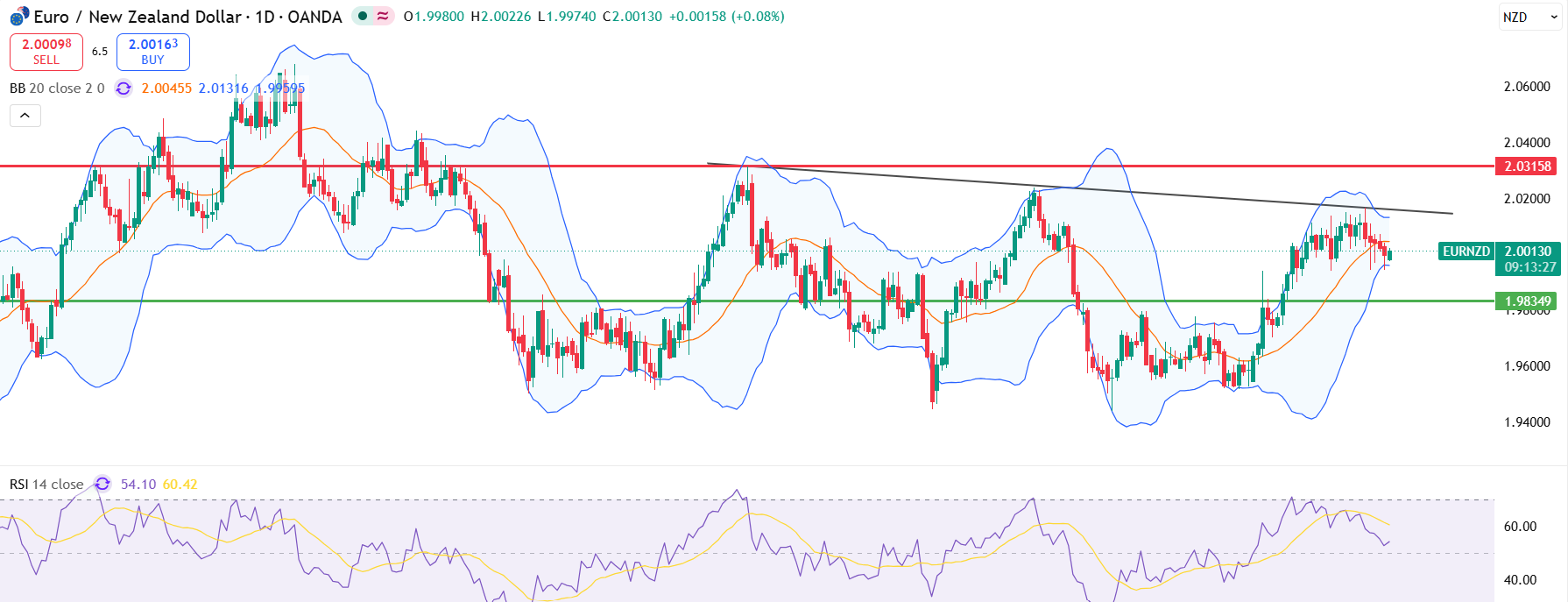
On the downside, the proposed levels are 1.9970, 1.9900 and 1.9820. These remain analytical reference points, not independently verified support levels. Claims about moving-average convergence, the Ichimoku cloud and weekly overbought conditions require separate chart confirmation.
Outlook: Relative Policy Expectations Matter
The bullish scenario depends on euro-area policy expectations strengthening relative to those in New Zealand, alongside a confirmed resistance breakout. The bearish scenario would gain credibility if the Kiwi receives stronger policy support and the EUR/NZD breaks below verified support.
New Zealand’s next inflation update is scheduled for 22 October, followed by the RBNZ’s policy decision on 28 October. These releases could help clarify whether further tightening will strengthen the Kiwi’s position against the euro.
Warning! This material is not intended as investment advice. Past performance data does not guarantee future returns. Investing in foreign currencies may affect your returns due to their fluctuations. Any transaction in securities may result in both profits and losses. The assumptions and expectations set forth in this material are only estimates that may not be accurate and may change depending on current economic conditions. These statements do not guarantee future returns.

Syam KP
Meet Syam KP, a financial markets professional with more than fourteen years of experience in forex, CFDs and capital markets. Since 2012, he has worked with several brokerage firms as a trader and market strategist, developing a practical understanding of how markets move. He also holds a qualification from CISI in the United Kingdom.
At FX Junction, Syam turns complex market information into clear and useful insights. His work combines technical and fundamental analysis, portfolio management, risk management and timely commentary on global developments. Whether markets are calm or moving fast, Syam focuses on what matters most: understanding the bigger picture, spotting meaningful opportunities and keeping risk firmly in view.
Related Articles
Dollar Strengthens Ahead of September Fed Minutes
Dollar strengthens ahead of September Fed minutes as investors assess further tightening. The immediate question for currency markets is how much additional tightening remains ahead.
Read More →Nasdaq Closes at Record High as Tech Rally Outweighs Yield Concerns
The Nasdaq Composite closed at a fresh record high on Monday as gains in major technology stocks and easing oil prices supported investor sentiment, outweighing concerns about elevated Treasury yields.
Read More →