Gold Slips Below $4,300 as Fed Fears Mount—Can Bulls Stage a Technical Rebound?
XAU/USD declined for a fourth consecutive session, touching an intraday low near $4,280—its weakest level in more than three weeks—before recovering modestly toward $4,320.
Stronger Dollar and Rising Yields Weigh on Gold
The latest decline has been driven largely by renewed strength in the US dollar and higher Treasury yields. The US Dollar Index climbed to a three-week high as investors reassessed the outlook for Federal Reserve policy.
Expectations that US interest rates could remain elevated—or even rise further—are reducing gold’s appeal. Because the metal does not generate income, higher bond yields increase the opportunity cost of holding it. A stronger dollar also makes dollar-denominated gold more expensive for buyers using other currencies.
Further gains in the dollar could maintain pressure on gold, particularly if economic weakness elsewhere continues to support demand for US assets.
US Employment Data Takes Centre Stage
Gold’s direction for the remainder of the week will depend heavily on incoming US labour-market data, comments from Federal Reserve officials and movements in Treasury yields. Geopolitical developments and broader risk sentiment could also influence demand for safe-haven assets.
The next major catalyst for XAU/USD is the US ADP National Employment Report. The August release is expected to show that private-sector employment increased by approximately 48,000 positions.
A result broadly in line with expectations would indicate that hiring remains positive but is losing momentum. The immediate market reaction could nevertheless be limited, with investors likely to avoid making large commitments ahead of the official US employment report due Friday.
Gold Technical Analysis: Rebound Possible, but Not Yet Confirmed
Although gold has recovered from its intraday low near $4,280, the technical picture remains fragile. The metal has fallen below both the Ichimoku cloud and the 50% Fibonacci retracement level, increasing the risk of accelerated selling if buyers fail to regain control.
The severity of the recent decline means a short-term corrective rebound remains possible. However, gold must reclaim the $4,300–$4,350 region to ease immediate bearish pressure. A sustained move above that zone could open the way for a test of the psychological resistance level at $4,400. Until then, any recovery should be viewed as a countertrend bounce rather than evidence that a durable bottom has formed.
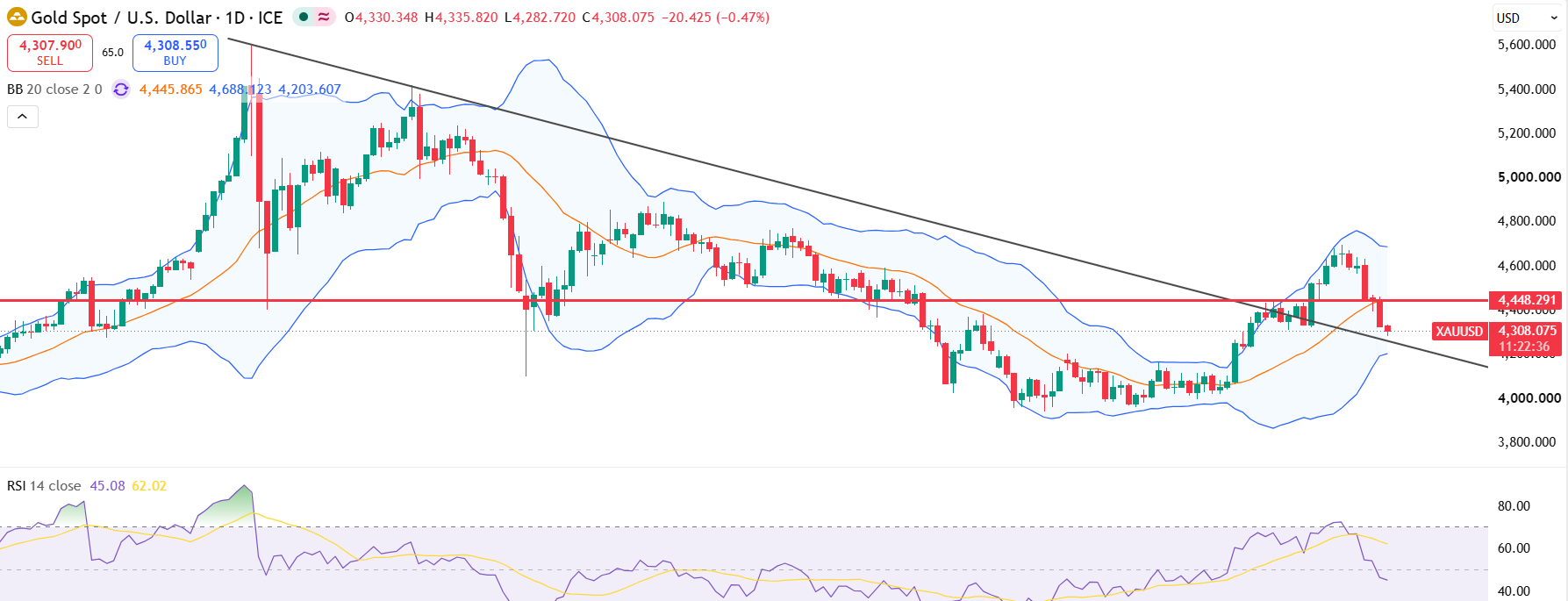
On the downside, $4,280 is the nearest support level. A decisive break below it could expose $4,240, followed by the crucial $4,220–$4,200 support zone. Failure to hold that area would materially weaken the broader technical outlook.
Bottom Line: A technical rebound is possible following the sharp four-session decline, but confirmation is still lacking. The next move will likely depend on whether US employment data and Federal Reserve commentary sustain the dollar’s advance. For gold bulls, reclaiming $4,350 would be an important first step toward $4,400. For bears, a break below $4,280 would shift attention to the key $4,220–$4,200 support area.

Meet Syam KP, a financial markets professional with more than fourteen years of experience in forex, CFDs and capital markets. Since 2012, he has worked with several brokerage firms as a trader and market strategist, developing a practical understanding of how markets move. He also holds a qualification from CISI in the United Kingdom.
At FX Junction, Syam turns complex market information into clear and useful insights. His work combines technical and fundamental analysis, portfolio management, risk management and timely commentary on global developments. Whether markets are calm or moving fast, Syam focuses on what matters most: understanding the bigger picture, spotting meaningful opportunities and keeping risk firmly in view.
Related Articles
Anthropic's Record $81 Billion IPO Loses Momentum After 34% Opening Surge
Anthropic shares surge during their Nasdaq debut before surrendering much of their early gains. Despite completing the largest initial public offering on record, the company's volatile first trading session raises questions about whether investor enthusiasm can sustain valuations amid rising AI infrastructure costs.
Read More →Australian Dollar Hits 10-Month Low as Unemployment Rises to 4.9%
The Australian dollar falls sharply after unemployment reaches its highest level in five years. With employment declining for a second consecutive month, investors are abandoning expectations of further interest-rate increases and increasingly pricing in cuts for 2027.
Read More →